Ad Frequency indicates the average number of times a person sees your advertisement.
In remarketing campaigns, this metric often increases quickly because ads are repeatedly shown to users who have already interacted with your brand.
A high Frequency does not automatically mean poor performance.
However, if Frequency continues to rise while CTR declines, CPA increases, or revenue remains unchanged, it’s time to optimize your campaign to avoid wasting your advertising budget.
Let’s find out with Nolimit Topup!
1. WHAT DOES AD FREQUENCY MEAN IN REMARKETING?
In remarketing campaigns, Frequency measures how often the same audience is exposed to your ads.
The ideal Frequency depends on several factors, including audience size, remarketing window, buying cycle, budget, and the number of creatives being used.
For this reason, there is no universal Frequency benchmark that applies to every campaign.
2. SIGNS YOUR REMARKETING AD FREQUENCY IS TOO HIGH
A high Frequency only becomes a concern when campaign performance starts to decline. Common warning signs include:
- Lower CTR
- Higher CPC or CPA
- Decreasing conversion rate
- Creative fatigue caused by repetitive ads
- No revenue growth despite increased ad spend

Instead of focusing on Frequency alone, advertisers should also evaluate CTR, CPA, and the performance of individual creatives to identify the real cause of declining results.
3. CONTROL REMARKETING FREQUENCY THROUGH AUDIENCE SEGMENTATION
One of the most effective ways to manage remarketing Frequency is to segment audiences based on user behavior and engagement period instead of targeting everyone with a single audience.
For example, audiences can be divided into:
- Product viewers
- Add-to-cart users
- Checkout initiators
- Existing customers
- Website visitors within the last 3, 7, 14, or 30 days
It’s also important to exclude customers who have already completed a purchase from campaigns that are no longer relevant.
Regularly updating audiences using website activity, video engagement, or CRM data can also help expand reach and reduce excessive ad repetition.
4. MANAGE FREQUENCY WITH BUDGET AND CREATIVE STRATEGY
Your campaign budget should match the size of your remarketing audience. If the audience is relatively small but the budget is too large, Frequency will increase rapidly.
In addition, regularly refreshing creatives, messaging, or promotional offers helps reduce ad fatigue.
When a creative reaches a high Frequency while CTR drops and CPA rises, it’s a clear signal that new creative assets should be introduced.
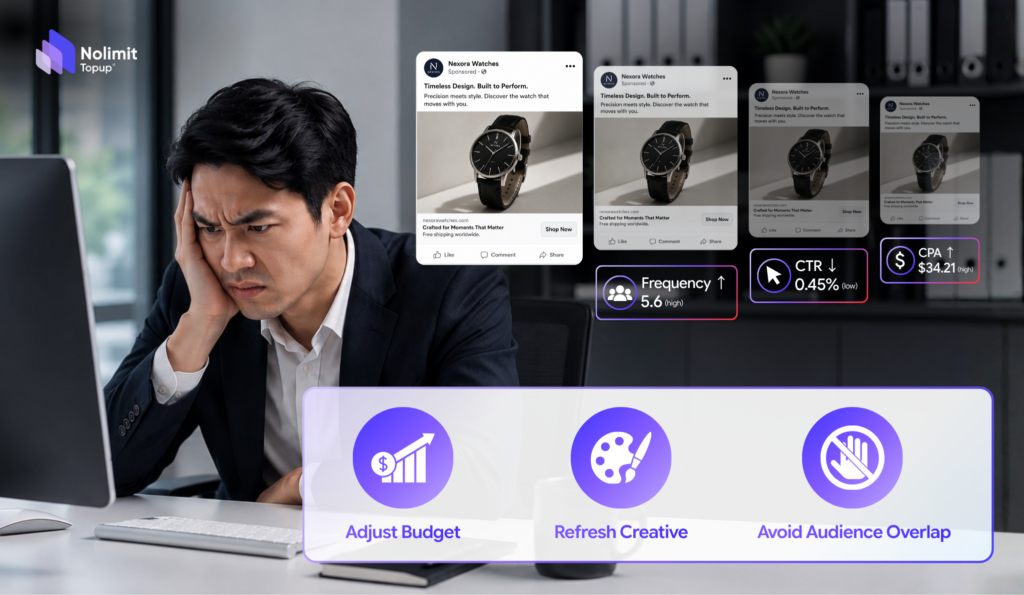
You should also check for audience overlap across multiple remarketing campaigns to prevent the same users from seeing ads from different campaigns simultaneously.
5. A PRACTICAL PROCESS FOR CONTROLLING REMARKETING FREQUENCY
An effective remarketing management process typically includes:
- Determining the size of each audience segment
- Allocating budgets appropriately
- Monitoring Frequency alongside CTR, CPA, and ROAS
- Rotating creatives on a regular basis
- Excluding converted customers
When managing multiple advertising campaigns, using a centralized platform to monitor budgets and performance can improve operational efficiency.
If additional advertising infrastructure is required, businesses may use rented ad accounts to expand capacity.
However, this should only serve as operational support rather than replacing proper audience segmentation, budget management, and creative optimization.
LAST BUT NOT LEAST
Controlling remarketing isn’t about keeping Frequency as low as possible. It’s about maintaining the right level of exposure to improve brand recall and drive more conversions.
With the right audience segmentation, budget allocation, and regular creative refreshes, remarketing campaigns can perform more efficiently while reducing wasted ad spend.
Leave a Reply